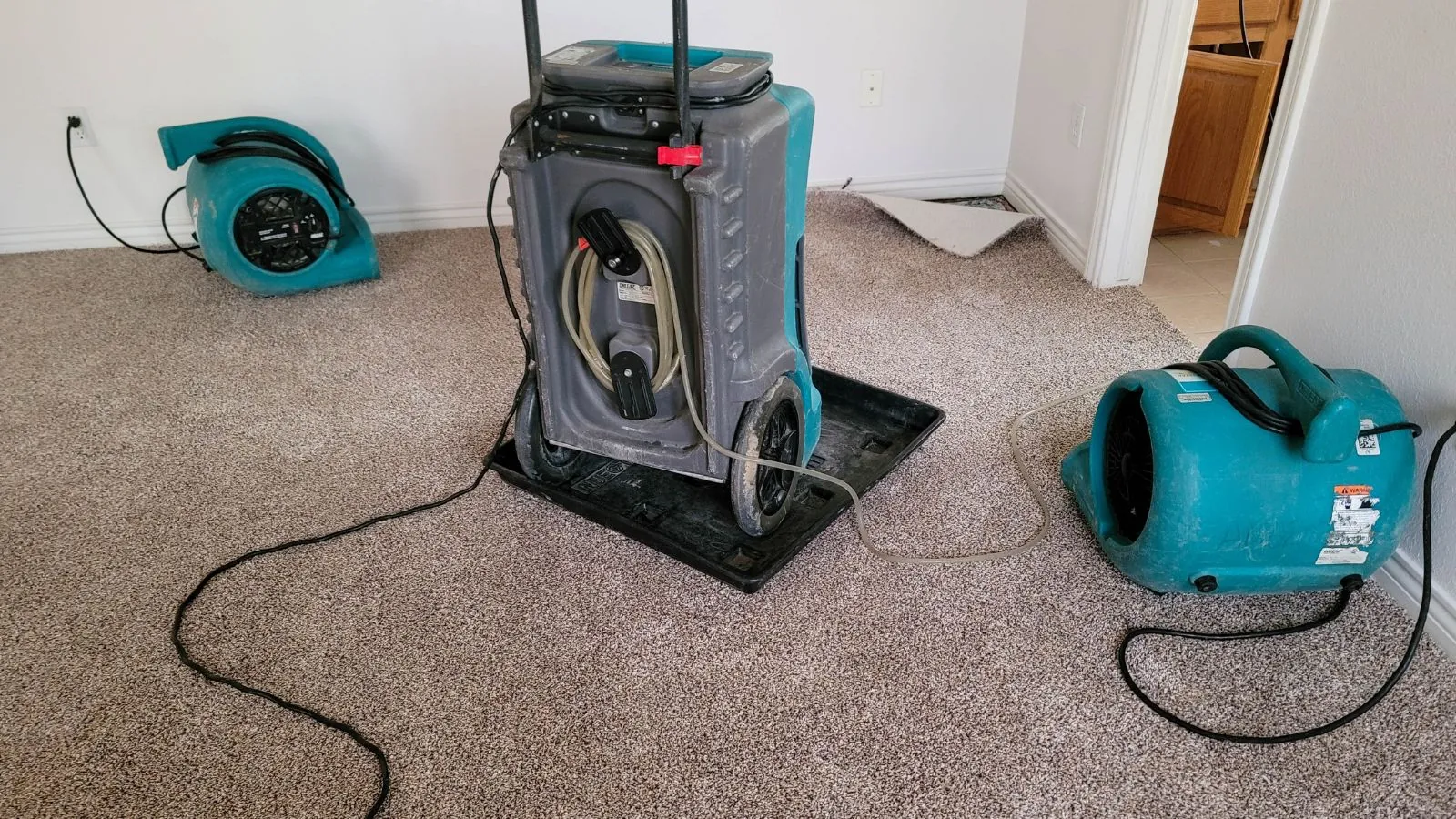
The honest answer: several days, and readings decide
Most clean-water losses take about three to five days of active drying, but a basement, thick framing or a large loss takes longer. We do not set a fixed number, because the right answer comes from moisture readings. The equipment leaves when the structure reaches the dry standard, not when a certain day arrives.
If you hear a quote of one day, ask what is being dried. Surfaces dry quickly, while framing, subfloor and wall cavities dry slowly.
What sets drying time
| Factor | Effect |
|---|---|
| Time before drying starts | Each day of delay lets water spread and soak deeper. |
| Amount of water | More water means more to remove. |
| Material | Concrete and dense wood dry slower than drywall. |
| Humidity | Humid air slows evaporation. |
| Temperature | Warmer air holds more moisture and speeds drying. |
| Airflow and dehumidification | Proper equipment placement is the biggest controllable factor. |
| Water category | Contaminated materials may be removed rather than dried. |
The drying stages
- Extraction removes standing water. See water extraction.
- Tear-out removes materials that cannot be dried.
- Air movers push air across wet surfaces and into cavities.
- LGR dehumidifiers pull moisture out of the air.
- Daily readings track progress, and equipment is adjusted.
- When materials reach the dry standard, equipment is removed.
The structural drying page explains the equipment. The ANSI/IICRC S500 approach uses a drying goal based on the dry standard for each material, which is why readings, not the calendar, decide.
Water on the floor right now?
Call the 24/7 line while you read the next steps.
Why household fans and dehumidifiers fall short
Household equipment moves less air and removes less moisture than commercial units. It also cannot tell you when the wall cavity is dry. A fan can dry a surface and leave moisture in the framing, which later shows up as a stain or a musty smell.
What you can do to help
- Keep windows and doors closed while equipment runs, since dehumidifiers work best in a closed space.
- Do not turn equipment off to save power. It is sized for the job.
- Keep pets and children out of the drying area.
- Let the crew take readings at each visit.
To start drying, call (636) 747-8964. The faster drying starts, the fewer materials have to come out.
What the daily visit looks like
On each visit the crew takes readings at the same marked spots on walls, floors and framing, records them and compares them to the prior day. If numbers are falling, equipment stays in place. If a spot stalls, the crew repositions air movers, opens a cavity or checks for a hidden source.
You can ask to see the log at any visit. Readings that drop steadily mean the job is on track. Readings that stay flat are a signal to look harder.
Why partial drying causes trouble later
Taking equipment out early is tempting, because it is loud and inconvenient. But a wall that reads dry on the surface and wet inside will cause bubbling paint, warped trim and mold later. Finishing the job to the dry standard is cheaper than repairing the aftermath.
The dry standard is based on the normal moisture level for each material in an unaffected part of the house. That comparison, not a fixed number, tells the crew when it is safe to stop.
Typical timeframes by situation
| Situation | What to expect |
|---|---|
| Small clean-water spill on one room, caught early | Often a few days of drying. |
| Wet drywall and insulation after a pipe leak | Several days, sometimes longer if cavities were opened. |
| Finished basement with carpet and drywall | Longer, because concrete holds moisture. |
| Hardwood floor with mat drying | Several days to over a week, depending on readings. |
| Large commercial space | Depends on volume and equipment, tracked by readings. |
These ranges are general descriptions and not guarantees. The crew sets a plan on the first day and updates it as readings come in. If the plan changes, you should hear why.
SafetyWhat to do before help arrives
- Keep the area closed while equipment runs.
- Do not turn equipment off to save power.
- Keep children and pets away from cords and hoses.
- Do not rehang drywall or lay flooring until readings are at target.
- Call if you smell mustiness after drying starts.
Drying in a humid climate
Humid summers in the St. Louis region make outdoor air a poor helper, so dehumidifiers do the work inside a closed house. Basements and crawl spaces take longer than upstairs rooms because they hold humidity and cool concrete. See basement water damage and crawl space water damage.
Drying times are no different in Cottleville or Earth City, though large commercial spaces need more equipment.
Local questions from Saint Peters homeowners
Why is the equipment so loud?
Air movers and dehumidifiers move a lot of air. The noise is the sign of drying, and it ends when the readings reach the dry standard.
Will the equipment raise my electric bill?
Yes, during the job. The crew can explain the number of units and the expected days so you can plan.
What if one wall stays wet?
The crew checks for a hidden source, such as a leak, or for a cavity that needs opening. Drying continues until the readings meet the standard.
Can I stay in the house while it dries?
Usually yes, though the noise and the equipment make some rooms hard to use. If the water was contaminated, the crew will tell you whether you need to stay out of the affected area.