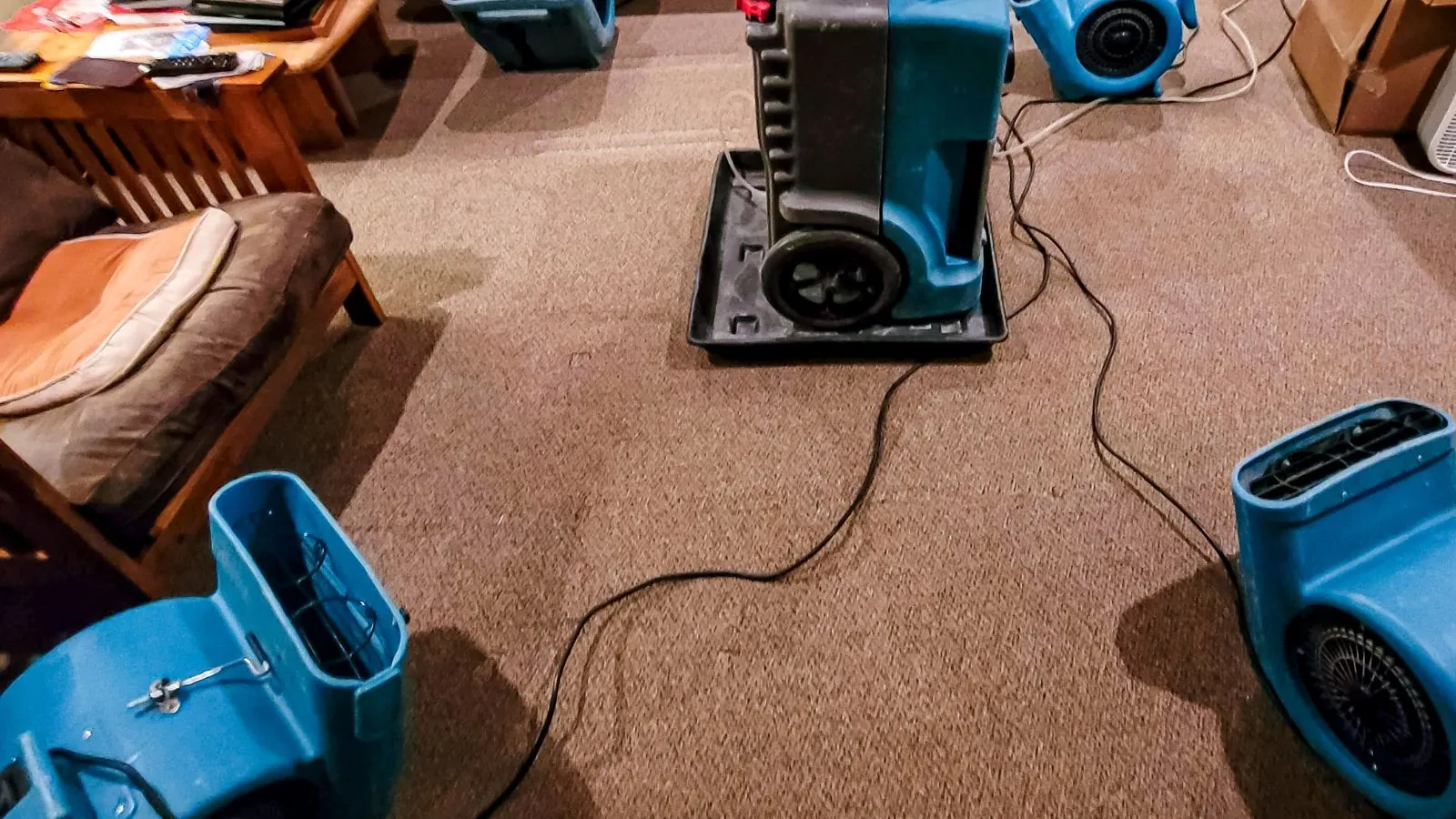
Water Damage Restoration in Saint Peters, MO
A burst pipe, a failed water heater, a sewage backup or a basement that took on water. Call the 24/7 line for water damage restoration in Saint Peters, MO, from the first extraction through drying and repair.
Water on the floor right now?
The dispatch line is answered 24 hours a day. Describe what you see and get the first steps.
Water damage restoration in Saint Peters, MO, from first call to final repair
Water damage restoration is the work of stopping the source, removing standing water, drying every wet material and then repairing what could not be saved. Done quickly, it keeps a wet room from turning into a rebuilt room. Done slowly, water wicks into drywall, subfloor and insulation, and mold gets a foothold.
Saint Peters Water Damage Pros runs a 24/7 phone line for homes and businesses in Saint Peters and the nearby towns of Cottleville, Earth City and Bridgeton. A dispatcher asks what the water is doing, tells you what to shut off, and sends a restoration crew as soon as one is available. Same-day response is the goal, and the dispatcher gives you a realistic window rather than a promise.
The industry standard for this work is ANSI/IICRC S500, which defines water categories, damage classes and drying goals. You can ask any company, including ours, whether its crews work to it. The same applies to S520 for mold. If you want the details on any one problem, start with the page for the source of your water, such as a burst supply line, a failed water heater or a sewage backup.
Pick the page that matches the water in your house
Twenty pages cover the different ways water gets into a Saint Peters home. They are grouped by cause so you can find the one that fits fast. Creek and storm water start at flood damage cleanup, while standing water of any kind starts at water extraction. Businesses along Mexico Road and Mid Rivers Mall Drive can go straight to commercial water damage.
Not sure which one applies? Call the line. The dispatcher sorts the source out in a minute or two, and the page that matches it is then a useful reference while you wait.
Burst Pipe Water Damage
A pressurized supply line let go. Shut-off steps, extraction and drying.
Frozen Pipe Water Damage
Ice split the pipe and the thaw is now flooding the wall or floor.
Water Heater Leak Cleanup
A failed tank or fitting has soaked the utility room and the rooms next to it.
Slab Leak Water Damage
A warm floor, a running meter or a wet slab edge. Water coming from under the house.
AC Leak Water Damage
A clogged condensate line or a frozen coil dripping into ceilings and closets.
Ceiling Water Damage Repair
Stains, sagging and collapse, including roof leaks that come through the attic.
Flood Damage Cleanup
Creek, surface and groundwater flooding that brings contaminated water inside.
Structural Drying
Air movers, dehumidifiers and moisture mapping until the readings say dry.
Hardwood Floor Water Damage
Cupping, crowning and boards lifting after water gets under the floor.
Wall and Drywall Water Damage
Wet drywall, baseboards and insulation inside the wall cavity.
Commercial Water Damage
Stores, offices and multi-unit buildings where downtime costs money.
What to do in the first hour while you wait for the crew
Water damage is an emergency from the first minute because every hour adds more wet material. These steps are what a dispatcher would tell you on the phone. Do only the ones that are safe for you to reach.
- Stop the source if you can. For a supply line, turn off the main water valve, usually where the line enters the house near the water meter.
- Turn off power to wet areas only if you can reach the panel without stepping in water. If water is near outlets, panels or appliances, stay out and call the utility or 911 first.
- Lift valuables, electronics, papers and rugs off wet floors. Pull cushions and boxes out of reach of the water.
- Keep people and pets out of any water that came from a drain, a toilet or outside. That water is contaminated until proven otherwise.
- Take photos and a short video of the damage before anything moves. Insurers ask for them.
- Call the 24/7 line at (636) 747-8964 and describe what you see.
Never wade into water that touches electricity
If water is covering outlets, a breaker panel or a running appliance, do not enter the room. Call the electric utility or 911 for any electrical or gas risk before you call us. Restoration can wait a few minutes. A shock cannot be undone.
What happens after you call, and why speed matters
The first three days decide how much of the structure can be saved. Wet drywall and carpet pad start to break down quickly, and the EPA advises drying wet materials within 24 to 48 hours to head off mold growth. A typical job moves through six stages.
The call and the safety check
The dispatcher asks where the water is coming from, how far it has spread and whether power or sewage is involved. You get shut-off and safety steps before anything else.
Assessment and moisture mapping
The crew finds the wet areas with moisture meters and, where useful, a thermal imaging camera. Water is sorted into a category and the damage into a class under S500, which sets the drying plan.
Extraction
Pumps, wet vacuums and extraction units pull out standing water and water held in carpet. Removing water as liquid is far faster than drying it as vapor.
Removal of what cannot dry
Saturated pad, ruined insulation and drywall that has gone soft are cut out so the cavity can breathe. Contaminated materials always come out.
Structural drying
Air movers and LGR dehumidifiers run for days while moisture readings are logged. The equipment stays until the readings reach the dry standard for that material. See structural drying and dehumidification for how this works.
Repair
Once everything reads dry, drywall, paint, flooring and trim go back. Repair scope and price are explained before the work starts.
Water damage repair in Saint Peters after the drying is done
Drying and repair are separate jobs, and homeowners often want one team for both. Repair covers whatever the water changed: soft drywall, swollen baseboards, cupped hardwood, a stained ceiling or carpet that could not be saved. The wall and drywall page covers cut-outs and finish work, and the hardwood floor page explains when boards can be dried in place and when they cannot.
Ceilings deserve a mention of their own. A stain that keeps growing usually means water is still arriving from a roof, an upstairs bathroom or an attic duct. The ceiling water damage page covers that, including roof leaks, because the repair starts with finding where the water came from.
What drives the cost of a water damage job
Nobody can quote a fair number over the phone without knowing what the water touched. These are the factors that move the price. When you call, the dispatcher can talk through them, and scope and price are explained before work starts.
| Factor | What it changes |
|---|---|
| Water category | Clean supply water is the simplest. Gray and black water add removal, disinfection and disposal steps. |
| Area affected | More square footage means more extraction time, more equipment and more materials to open up. |
| Materials involved | Carpet, hardwood, drywall and plaster dry differently. Some can be saved and some cannot. |
| Days of drying | Air movers and dehumidifiers are tracked per day, so a slow-drying structure costs more than a quick one. |
| Rebuild scope | Repair is priced separately from mitigation and depends on how much material was removed. |
Insurance works the same way everywhere in general terms. Sudden and accidental water damage, such as a burst pipe, is often covered. Gradual leaks and neglect often are not. Flood damage from outside water is usually excluded from a standard homeowners policy and needs separate flood coverage. Check your policy or ask your insurer, because only the policy decides.
Document everything for the claim
Photograph each wet room before cleanup, keep damaged items until the adjuster has seen them, save receipts for emergency costs and write down the time you noticed the water. Our crews log moisture readings daily, and that record helps support a claim. We never promise a claim will be approved.
Larger losses, where several rooms or floors are affected, benefit from an early written scope. Ask for it on the first call so you and your adjuster are looking at the same numbers.
Creeks, storms and older roofs: what water does in Saint Peters
Saint Peters sits in St. Charles County close to Dardenne Creek, and that creek has a documented history.
The NOAA stream gauge at Dardenne Creek in Saint Peters lists flood stage at 18 feet and a record of crests that includes 23.50 feet on July 26, 2022, a major flood level. NOAA also logged crests of 21.42 feet in November 2024 and 21.43 feet in April 2025. If your home or business is near the creek, check the FEMA flood map for your address and ask your insurer about flood coverage before the next storm.
The July 2022 event was extreme. The National Weather Service reported upwards of 11 inches of rain over roughly eight hours along an axis running from Hawk Point to Saint Peters, and NOAA recorded 12.34 inches at Saint Peters. For homeowners the lesson is practical. Heavy rain overwhelms sump pumps, floor drains and gutters at the same moment, so check that your pump has a battery backup and that downspouts discharge well away from the foundation.
Fall storms matter too. NWS St. Louis spotter and station reports on November 5, 2024 showed storm totals between about 4 and 6.7 inches around Saint Peters. Wet ground like that pushes water through basement walls and window wells even when no creek is involved. Our basement water damage page covers seepage and sump failure, and the storm water damage page covers wind-driven rain that gets in through the roof and siding.
Closer to the daily routine, plenty of water damage here starts indoors. Supply lines, water heaters and washer hoses fail in homes of every age from the Mexico Road corridor to the neighborhoods near City Centre Park and the St. Peters Rec-Plex. Rabbit Run Park, which sits on Dardenne Creek, is a reminder of how close ordinary neighborhoods are to the water.
Where the 24/7 line sends crews
Home base is Saint Peters, ZIP 63376, and the line also covers the St. Charles County side of Cottleville, where mail runs through 63338, 63304 and 63376. East of town, crews work in Earth City, ZIP 63045, and Bridgeton, ZIPs 63044 and 63045, in St. Louis County.
Coverage also reaches neighboring communities such as O'Fallon, Saint Charles, Lake Saint Louis and Wentzville. If your address is in between, call and ask. The service area page lists how each town is covered, and Cottleville has its own page too.
Cottleville, MO
St. Charles County, ZIP 63338
Earth City, MO
St. Louis County, ZIP 63045
Bridgeton, MO
St. Louis County, ZIP 63044
Saint Peters, MO
St. Charles County, ZIP 63376. Home base and the primary dispatch area.
Neighborhoods We Serve
Four Saint Peters areas have their own pages, each built from public records about that part of the city and practical steps for water damage there.
Old Town St. Peters
The historic district between Dardenne Creek and Spencer Creek.
Spencer Creek
A residential area around Spencer Creek Park and the creek trail.
Cave Springs Estates
A residential subdivision in ZIP 63376.
Mid Rivers
The shopping and business corridor along Mid Rivers Mall Drive.
What you can expect from the line
These are plain commitments rather than slogans. They describe how the line works.
24/7 dispatch
The phone is answered at any hour, including nights, weekends and holidays.
Scope first
Scope and price are explained before work starts, so there are no surprises.
Clear process
Extraction, drying, monitoring and repair are explained in order.
Written record
Moisture readings and photos are documented to support your claim.
Water damage questions from Saint Peters homeowners
How fast can someone get to my Saint Peters home?
Same-day response is the goal when crews are available, and the dispatcher gives you a realistic window on the call. We do not promise a fixed arrival time, because traffic on I-70 and the number of active jobs change it. While you wait, the dispatcher walks you through shutting off water and protecting belongings.
Do you handle water damage emergencies at night or on weekends in Saint Peters?
Yes. The dispatch line is answered 24 hours a day, every day, including holidays. A burst pipe at 2 a.m. gets the same first steps as one at noon, and crews are sent as soon as one is available.
Will my homeowners insurance cover the damage?
It depends on the cause and your policy. Sudden and accidental damage, such as a burst pipe or a failed water heater, is often covered, and gradual leaks and flood water from outside often are not. Photograph everything, keep damaged items for the adjuster and ask your insurer what applies. We document moisture readings and scope, and we never promise approval.
How much does water damage restoration cost?
It depends on the water category, the area affected, the materials involved, how many days of drying are needed and how much has to be rebuilt. Scope and price are explained before work starts. Describe the situation on the phone and the dispatcher can tell you which factors apply.
Should I clean up the water myself before the crew arrives?
Stop the source, protect valuables and remove only clean surface water if it is safe. Do not run household fans over contaminated water, and do not pull up flooring or cut drywall before the damage is documented. Wet materials are heavy, and electrical hazards are easy to miss.
Is water damage restoration the same as basement waterproofing?
No. Restoration cleans up and dries what the water damaged. Waterproofing changes the foundation, drainage or grading so water stays out in the future. If your basement keeps taking on water, restoration handles the damage and a waterproofing or drainage specialist handles the cause.
How much notice do you need before someone can look at the damage?
Call the line and the dispatcher will tell you what is available today. For active leaks, same-day response when available is the goal. For older stains, a visit can usually be scheduled around your day, and the assessment explains what is wet and what is not.
How long does it take for mold to start growing after water damage?
Mold needs moisture, and the EPA advises drying wet materials within 24 to 48 hours to avoid growth. That is why the first two days matter so much. Our mold remediation page explains what follows when it has already started, including clearance testing.
Water Damage Will Not Wait for Morning
Call the 24/7 line from the driveway, the kitchen floor or the basement stairs. A dispatcher will walk you through the first steps.
Call (636) 747-8964